 ProRata Calculate
Pro Rata Holiday Entitlement for Part-Time Workers — The Full Picture
How pro rata holiday entitlement is meant to be worked out for part-time workers — the legal minimum, bank holidays, and how to check your own contract in about ten minutes.
Start from the legal floor: 5.6 weeks, for everyone
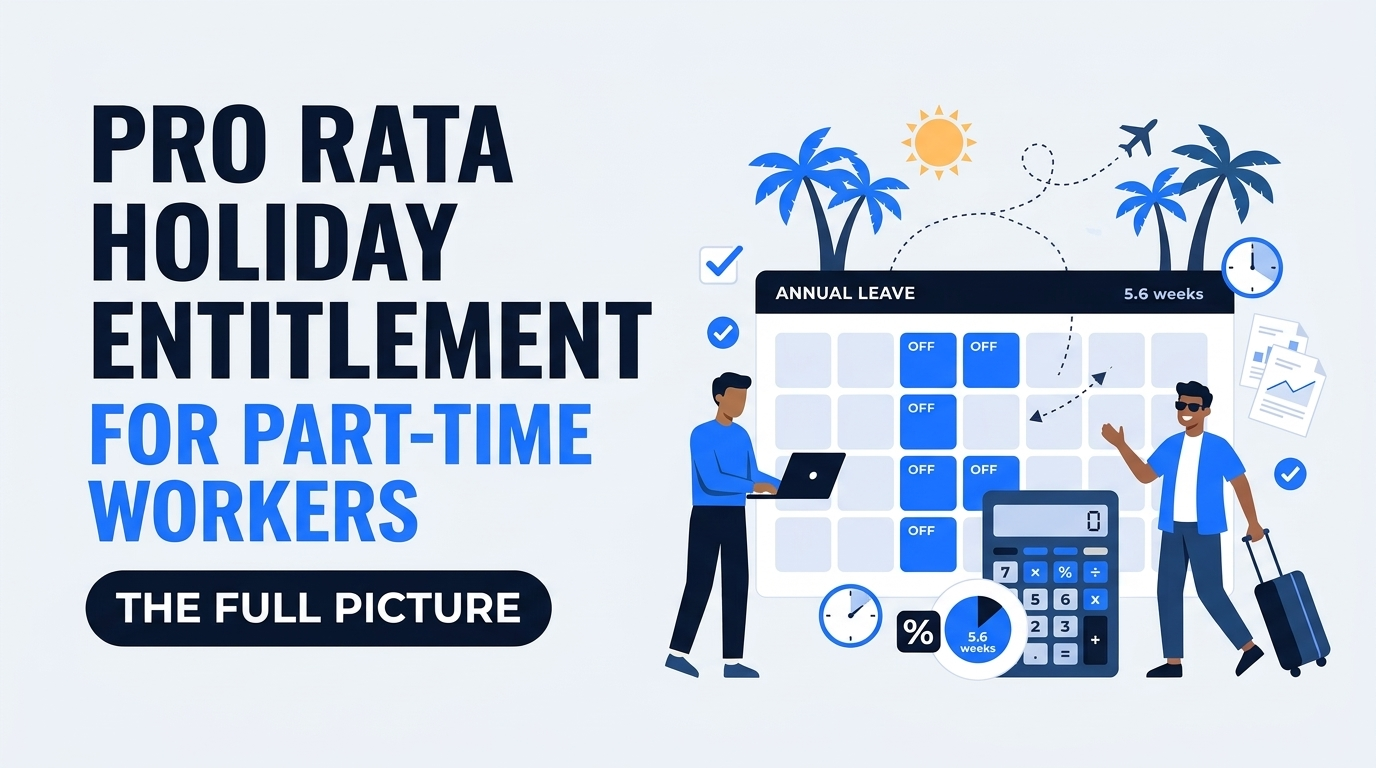
Every worker in the UK is entitled to at least 5.6 weeks of paid annual leave. The phrase that matters is weeks of your own pattern. A week for a full-time colleague is five days; a week for you is however many days — or hours — you normally work. Multiply 5.6 by your weekly days and you have your statutory minimum in days: 16.8 days on a three-day pattern, 11.2 on a two-day pattern, 22.4 on a four-day pattern. Employers can be more generous, and many are, but nobody can be less generous than that line. Anything in your contract that produces less than 5.6 of your weeks is not a policy choice; it is an error, and it is fixable.
Notice what is not in the rule: there is no waiting period, no requirement to have worked a full year before leave exists, and no lower tier for part-time staff. Entitlement accrues from day one, and in your first year an employer may operate an accrual system of one twelfth per month — which is still your full entitlement, just released monthly.
How a fair entitlement is built, step by step
Take the full-time entitlement exactly as written in a full-time colleague’s contract — including any extra days the employer gives beyond the minimum, because those extra days pro rata too unless the contract clearly reserves them. Multiply by your fraction. That is the whole construction. If full-time staff receive 30 days including bank holidays and you work 0.6 of the week, your entitlement is 18 days, of which 4.8 days represent bank holidays. The two mistakes to hunt for are an employer pro-rating only the statutory 28 while quietly keeping contractual extras at full-time only, and an employer pro-rating twice — once on the salary fraction and again “because you don’t work Mondays”. Either shows up immediately when you rebuild the figure yourself with the holiday calculator.
Examples from real contract styles
Public-sector style, generous entitlement. Full-time leave is 33 days including public holidays. At 22.5 hours of a 37.5-hour week (0.6), entitlement is 33 × 0.6 = 19.8 days, or 148.5 hours at 7.5 hours a day. The 0.8 of a day is real entitlement — a good employer records it in hours precisely so fractions like this are not lost.
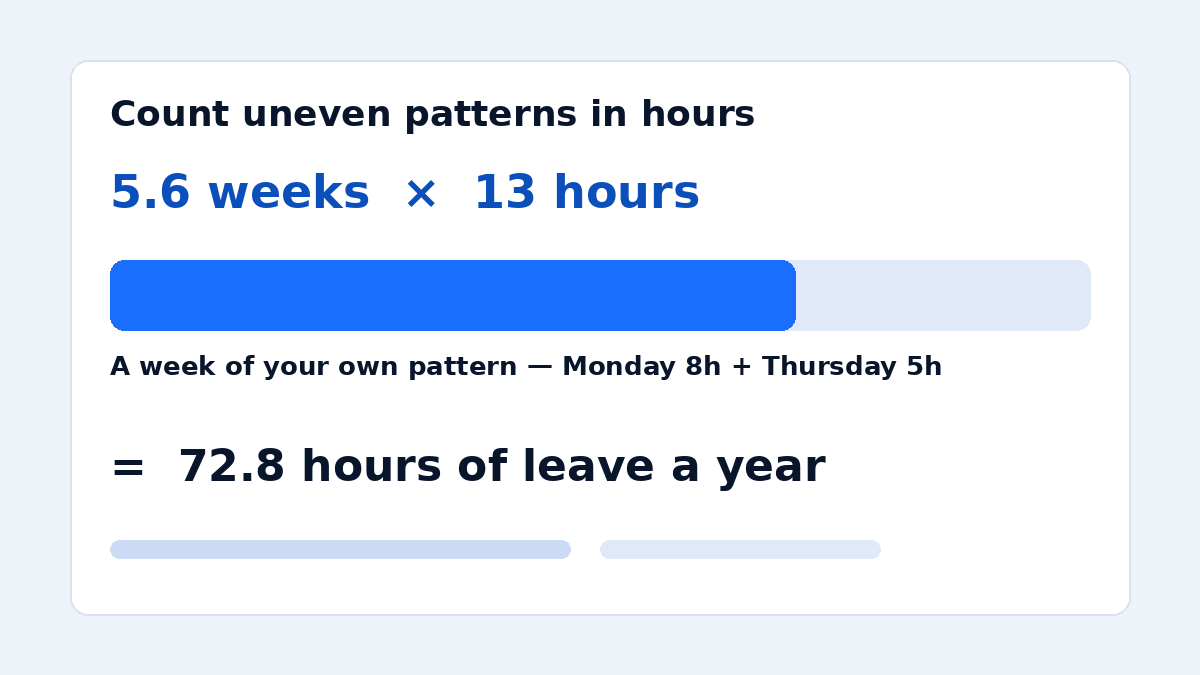
Retail style, statutory only, uneven days. You work Mondays (8 hours) and Thursdays (5 hours): 13 hours a week. Your minimum leave is 5.6 × 13 = 72.8 hours a year. Counted in “days” this would be a mess; counted in hours it is exact, and a week off costs 13 hours from the pot.
Changing hours mid-year. Six months at 0.8 FTE on a 28-day entitlement earns 11.2 days; six months at 0.5 earns 7 days; total 18.2 days, minus whatever you already took. If payroll simply applied 0.5 to the whole year you would be shown 14 days — over four days short. Mid-year changes are the single most common source of leave errors we hear about, and the two-slice method on the FAQ below is the fix.
Auditing your own leave in ten minutes
Write down four numbers: the full-time entitlement from a full-time contract (ask HR if you cannot see one), your fraction, the entitlement showing on your HR system or payslip portal, and the leave you have already taken this year. Multiply the first by the second and compare with the third. If they differ, screenshot both figures and email payroll asking which full-time entitlement and which fraction they used. Keep the exchange factual and in writing; in our experience most discrepancies are configuration errors in the HR system — a fraction updated for pay but not for leave after an hours change is the classic — and they are corrected without argument once the arithmetic is on the table. If an employer refuses to correct a figure below the statutory floor, Acas early conciliation is free and is the normal next step before any tribunal claim.
One last check: leave you were unable to take because of maternity, adoption or long-term sickness has special carry-over protection, and leave accrued during those absences continues at your normal fraction. If you are returning from any of them, ask specifically for your carried-over balance in writing before you book anything.
Questions people ask
Statutory leave generally has to be taken in the year it accrues, with limited carry-over where you were on maternity, adoption or long-term sick leave, or where your contract allows it. Many employers permit a few days by agreement. Ask before the year ends — after it ends, the default answer is usually no.
It can short-change you, which is why Acas guidance favours hours for uneven patterns. A day-based system is not automatically unlawful, but the total value you receive must still equal at least 5.6 weeks of your actual working time. If booking your longest day costs the same as your shortest, total up your hours across the year and compare — the hours calculator on this site makes the gap visible.
Your entitlement should be recalculated in two slices: the old fraction for the part of the year already worked, the new fraction for the rest, minus leave already taken. Employers sometimes apply the new fraction to the whole year, which can leave you owing days or owed days. Ask for the two-slice calculation in writing.
Term-time leave is normally built into the paid-weeks figure rather than taken as separate days: you are paid for term weeks plus at least 5.6 weeks of holiday, and the school holidays are when that leave is treated as taken. You usually cannot book additional leave in term time. The teacher calculator shows the paid-weeks arithmetic.
Rates used: UK tax year 2026/27 · Last reviewed: October 2026. Calculations run in your browser — nothing you type is sent anywhere or stored by us.