 ProRata Calculate
How to Calculate Pro Rata Salary — And How to Work Out Pro Rata Salary by Hand
How to work out pro rata salary by hand, in four steps — with worked examples you can use to check any advert, offer letter or payslip.
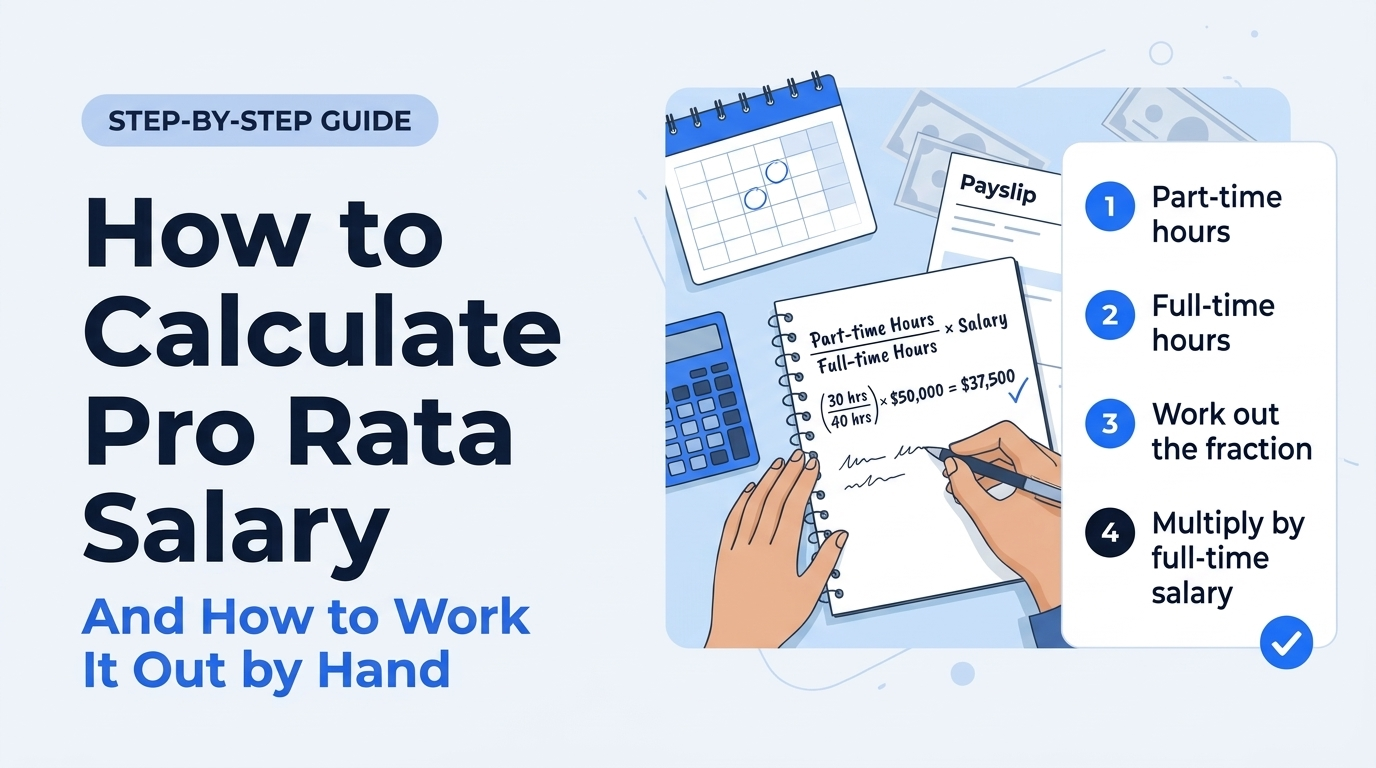
The four steps
Step 1 — find the full-time salary. This is the annual figure for the whole job, before any reduction. Adverts print it next to the words “pro rata”; if an advert prints only the reduced figure, ask for the full-time equivalent in writing, because every later step depends on it.
Step 2 — find the full-time pattern. Hours per week (37.5 and 40 are the commonest in the UK) or days per week (usually 5). Use the pattern of the workplace you are joining, not a national standard — there isn’t one. Schools often use 32.5 or 37 directed hours; the NHS standard is 37.5; many private firms use 40.
Step 3 — build your fraction. Your hours ÷ full-time hours, or your days ÷ full-time days. Write it as a decimal: 22.5 ÷ 37.5 = 0.6. This fraction is also your FTE, and it will reappear in your leave, your pension and most allowances — check it once, carefully, because a wrong fraction quietly multiplies through everything.
Step 4 — multiply, then divide for the periods you need. Full-time salary × fraction = your annual salary. Divide by 12 for monthly gross, by 52 for weekly. That is the complete answer to “how to calculate a pro rata salary” — everything else in this guide is examples, variations and traps.
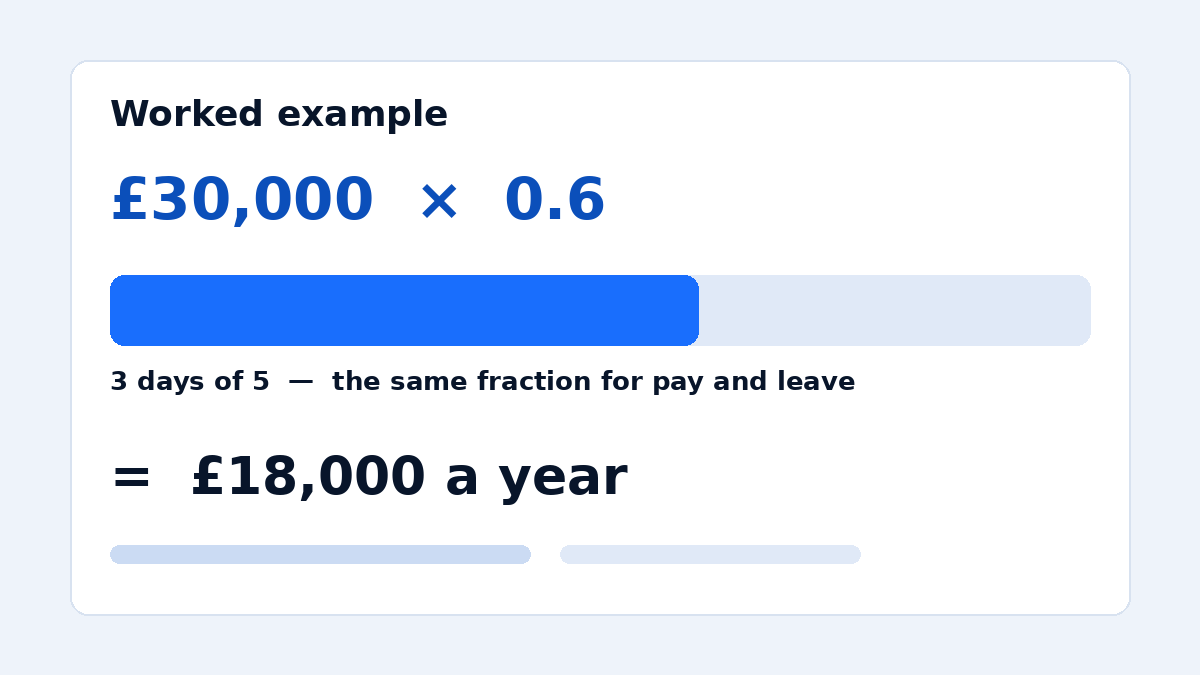
Example 1 — £30,000 pro rata at three days a week
The advert: “£30,000 per annum pro rata, 3 days per week (22.5 hours), full time 5 days (37.5 hours).” Fraction by days: 3 ÷ 5 = 0.6. By hours: 22.5 ÷ 37.5 = 0.6 — reassuringly identical, because the days are full-length. Annual pay: £30,000 × 0.6 = £18,000. Monthly: £1,500. Weekly: £346.15. Hourly rate check: £30,000 ÷ (37.5 × 52) = £15.38, and £18,000 ÷ (22.5 × 52) is also £15.38. When both routes agree and the rates match, the calculation is right — this is the example behind the thousands of “30000 pro rata” searches every month, and now you can answer it for any hours: at two days the same post pays £12,000, at four days £24,000.
Example 2 — £25,000 pro rata at 20 hours
The advert: “£25,000 pro rata, 20 hours per week, full time 40 hours.” Fraction: 20 ÷ 40 = 0.5. Annual pay: £25,000 × 0.5 = £12,500, which is £1,041.67 a month. Note the tax position changes character at this level: with a personal allowance of £12,570 in 2026/27, a salary of £12,500 sits just under the threshold, so income tax would be nil and National Insurance nil on this salary alone — a reminder that halving the salary can more than halve the deductions. Anyone weighing a move to half-time should run the salary calculator’s take-home panel, because gross comparisons flatter the full-time option.
Example 3 — uneven days, where hours win
You work Mondays and Tuesdays at 8 hours and Fridays at 4: 20 hours a week, across 3 days, in a 37.5-hour, 5-day workplace. The days fraction (3 ÷ 5 = 0.6) is wrong for you, because your days are not full-time days. The hours fraction is 20 ÷ 37.5 = 0.5333. On a £33,750 full-time salary, hours give £18,000; days would have promised £20,250 and left you £2,250 a year short of your own expectation when payroll — correctly — used hours. Rule of thumb: whenever your working days differ in length from each other or from a standard day, insist on the hours calculation, for leave as well as pay.
Example 4 — term time, the two-step version
A term-time post advertises a full-time equivalent of £26,940 at 32.5 hours. You will work 25 hours, 39 weeks a year, plus 5.6 weeks of paid holiday: 44.6 paid weeks. Step one, hours: 25 ÷ 32.5 = 0.7692. Step two, weeks: 44.6 ÷ 52 = 0.8577. Combined: £26,940 × 0.7692 × 0.8577 = £17,774 a year, paid in twelve instalments of £1,481.17. Offer letters that apply only one of the two steps are wrong by thousands, in one direction or the other — the teacher calculator shows both steps explicitly so you can point at the missing one.
The four mistakes that produce wrong figures
Using the wrong full-time hours. Assuming 40 when the workplace uses 37.5 inflates your fraction by 6.7% — enough to make a correct offer look stingy. Pro-rating the personal allowance. It is never pro-rated; leave tax allowances whole. Dividing the year by 52.14 in one place and 52 in another. Either is defensible, mixing them is not. Rounding the fraction early. 0.8577 rounded to 0.86 before multiplying costs or gifts real money on a salary; keep four decimal places until the final figure. Our article on part-time pay mistakes tells the stories behind each of these, including the payslips that exposed them.
And if the numbers in front of you come from an advert rather than a contract, read our companion piece on checking a pro rata job advert before you apply — adverts hide the full-time hours more often than contracts do.
Questions people ask
Identically: find the fraction of the period or pattern, multiply the full amount by it. A £1,300 annual service charge for seven months of ownership is £1,300 × 7/12 = £758.33. Salary, rent, fees and refunds all obey the same one-line rule.
Average them over a sensible reference period — most employers use the last 12 weeks, mirroring holiday-pay law — then build the fraction from the average. Keep your own rota records; an average built from your actual shifts beats one built from a guessed establishment figure.
A few pounds across a year usually means a rounding or divisor difference (52 weeks versus 52.14, for instance) and is worth a polite query, not a grievance. A difference of a percent or more means an input differs — the salary, the hours or the fraction — and that is worth pursuing until the inputs agree.
Work backwards: your gross pay divided by your fraction is the full-time salary payroll is using. If that reconstructed figure is not the advertised full-time salary, one of the two documents is wrong. The reverse calculator does the division for you.
Rates used: UK tax year 2026/27 · Last reviewed: October 2026. Calculations run in your browser — nothing you type is sent anywhere or stored by us.