 ProRata Calculate
Five Pro Rata Pay Mistakes — and How to Check Your Own Payslip
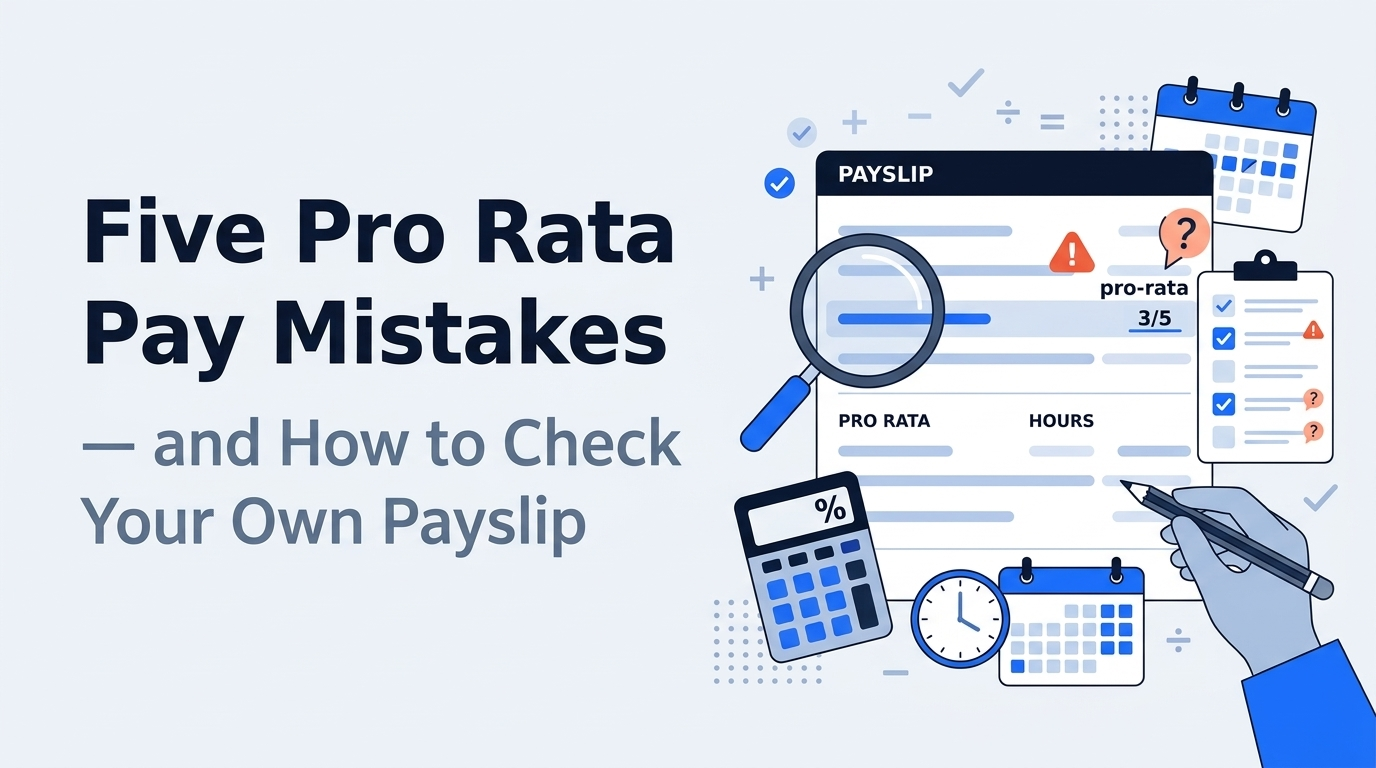
Most pro rata pay errors are not conspiracies. They are configuration slips: a fraction updated in one field of a payroll system and not another, a template built for five-day staff applied to everyone, a weeks figure carried over from an old contract. The unfortunate part is that they nearly all err in the same direction, and they persist for years because part-time payslips are hard to read even when they are right. Here are the five we see described most often — and the check that exposes each one.
Mistake one: holiday counted on the wrong days
You work Tuesday to Thursday. Your leave is recorded as 16.8 days — correct arithmetic for a three-day pattern on a 28-day entitlement. But the system deducts a full five days when you take a week off, because the absence template still thinks in full-time weeks. By August you have “used” leave you never took. The check: pick your last full week of leave and count what was deducted. It should equal your working days that week — three, in this pattern. If it says five, the entitlement figure may be right while the deduction logic is wrong, which is why this error survives casual inspection. Hours-based recording, explained on our entitlement guide, makes the whole class of error impossible.
Mistake two: 52 weeks here, 52.14 weeks there
A year is 52 weeks and a day. Payroll systems variously divide annual salary by 52, 52.14 or 52.18 to reach weekly or hourly rates, and all three conventions exist in reputable software. The mistake is mixing them: your salary built with 52, your hourly rate audited with 52.14, producing a rate that looks 0.3% light and a monthly figure nobody can reconcile. The check: multiply your payslip hourly rate by your contracted hours and by 52. You should land back on your annual salary (to within a pound or two). If you land 0.3% away, you have found a divisor mismatch — small money, but a reliable sign the setup deserves a second look before bigger figures are trusted.
Mistake three: the shrinking personal allowance
This one usually appears in conversation rather than on the payslip itself: “your tax-free allowance is pro rata too, of course.” It is not. The personal allowance — £12,570 in 2026/27 — belongs to the person, not the post, and it is never reduced for part-time work. Neither, for that matter, are the tax band thresholds applied to your income; what changes is simply that a smaller salary uses less of them. The check: on your P60 or payslip year-to-date, tax should be roughly 20% of the amount by which your pay exceeds £12,570 (for a standard tax code in England, Wales or Northern Ireland, before pension effects). If a colleague or a payroll note suggests your allowance was scaled to your hours, ask for it in writing and then take that writing to HMRC’s guidance — the allowance does not shrink, and neither should anyone’s story about it.
Mistake four: term-time paid weeks gone missing
A term-time salary must include paid holiday weeks — at least 5.6 of them — on top of the weeks worked. The classic error is building the salary from term weeks alone: 39 ÷ 52 instead of 44.6 ÷ 52, an underpayment of over 10% that hides inside a plausible-looking monthly figure. It often starts life in a spreadsheet where the holiday cell was left at zero “to be confirmed”. The check: ask for the paid-weeks figure in your contract or from payroll. If it equals your term weeks, the holiday weeks are missing. Our term-time calculator shows the correct construction line by line, which makes the conversation with payroll admirably short.
Mistake five: the fraction that froze
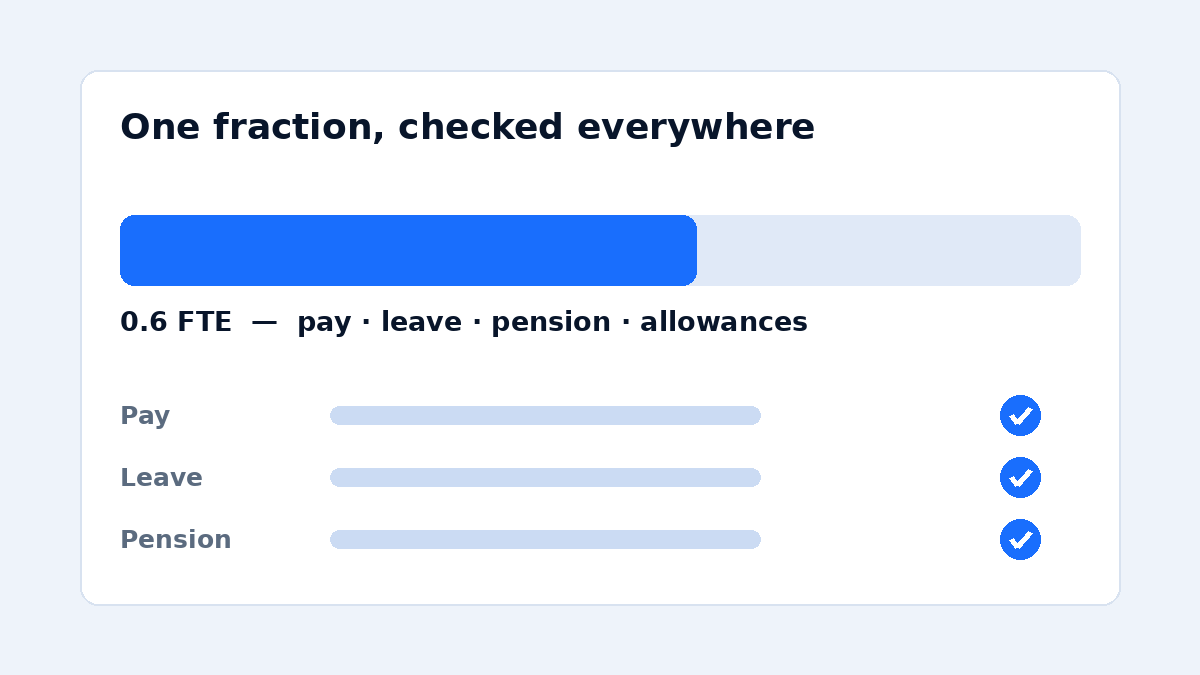
You changed your hours — up in September, down after parental leave, sideways in a restructure. Pay was updated. Leave, pension percentages or an allowance were not, because in many systems each entitlement carries its own copy of your fraction. Months later you discover leave accruing at the old rate or contributions set by a pattern you no longer work. The check: after any hours change, list every figure on your next payslip that depends on a fraction — salary, leave balance, pension, allowances — and recompute each one from your new fraction using the calculators on this site. Ten minutes, once, beats a year of drift.
How to raise it when you find one
Write to payroll with three things: the figure you expected, the figure you received, and the inputs you used (full-time salary, hours, fraction). Attach the working — every calculator on this site prints its arithmetic, and a query with the sums attached is answered faster and more carefully than “my pay looks wrong”. Keep it courteous and keep it in writing. In the great majority of cases you will get a correction and, where you were underpaid, back-pay; where an employer disputes a figure below a statutory floor such as holiday entitlement, Acas offers free early conciliation and Citizens Advice will check your arithmetic without charge. And keep your own copies of contracts, offer letters and hour changes somewhere that is not your work laptop. The fraction is only ever a few numbers — but they are your numbers, and they are worth ten minutes a year.
Check your leave → · Previous: decoding pro rata job adverts →

Recent articles & guides
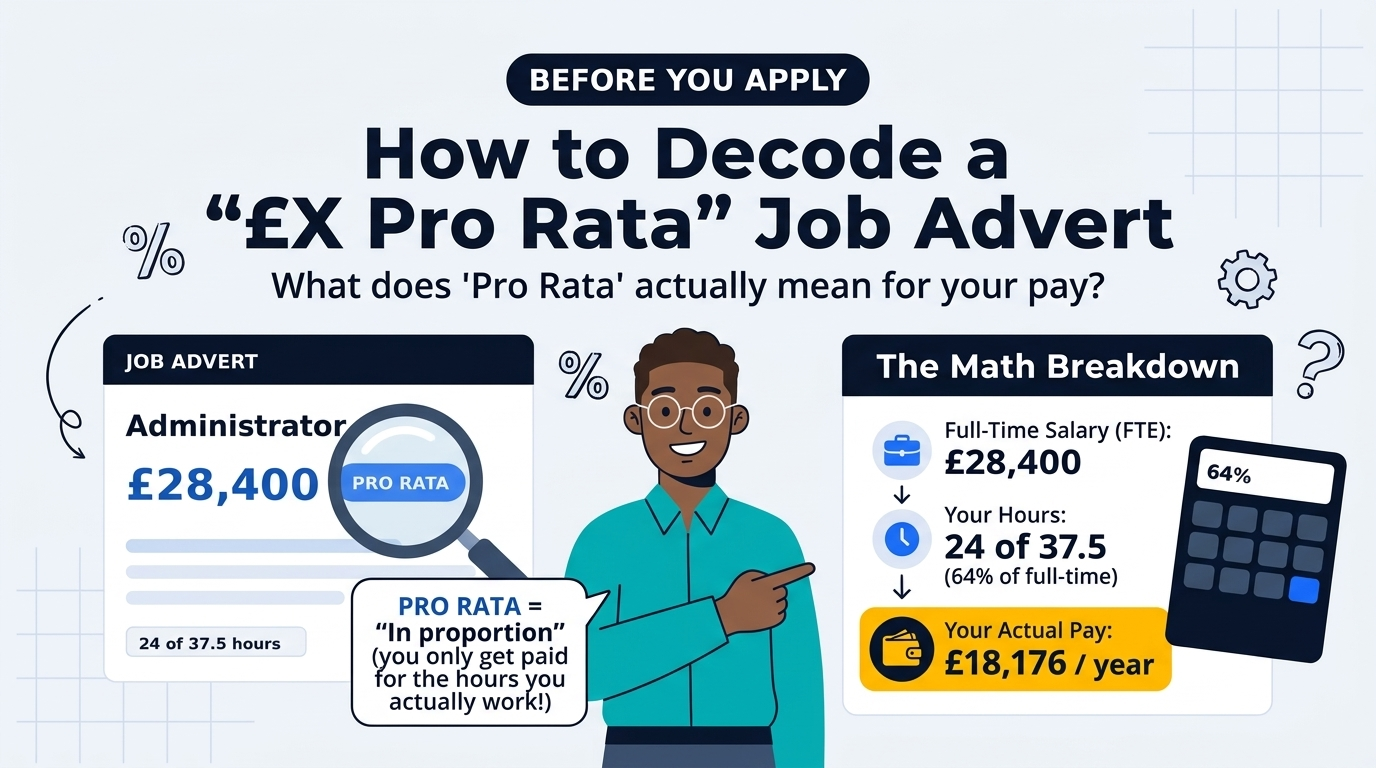
Before You Apply: How to Decode a “£X Pro Rata” Job Advert
Three real-style adverts decoded line by line — plus the three questions to ask any employer who quotes a pro rata figure.

Pro Rata Holiday Entitlement for Part-Time Workers
The 5.6-week legal floor, bank holidays, mid-year hour changes and auditing your own leave in about ten minutes.

What Does Pro Rata Mean?
The phrase decoded in plain English — what it does to a salary, and how the same idea applies to holiday, rent and refunds.