 ProRata Calculate
What Does Pro Rata Mean? The Meaning Behind the Phrase on Every Advert
What “pro rata” means, in plain English: what it does to a salary, and how the same idea applies to holiday, rent and refunds.
The definition, without the Latin fog
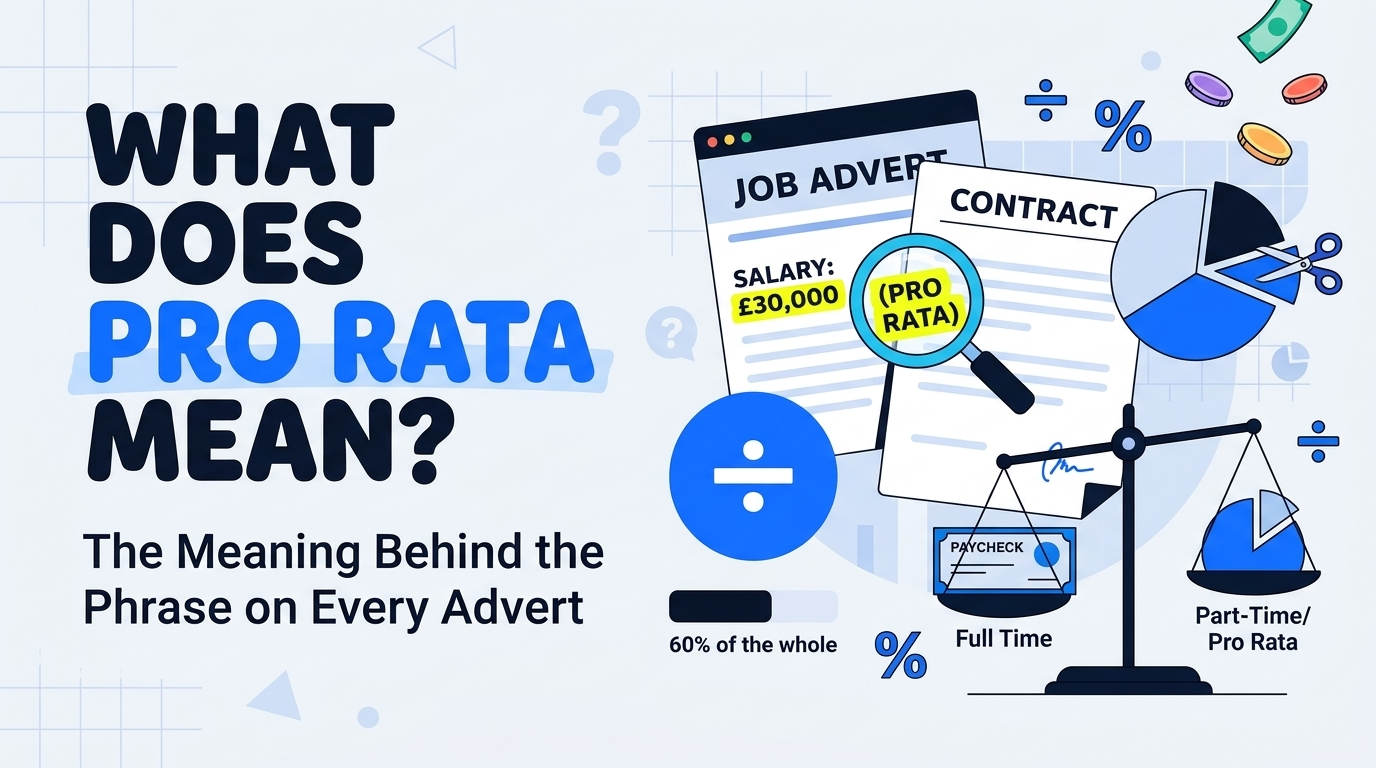
Pro rata comes from the Latin phrase meaning in proportion — literally, “according to the rate”. Something shared pro rata is shared in proportion to a measure: hours worked, days occupied, time elapsed, money contributed. If you use 60% of something, you pay 60% of its full price, receive 60% of its full benefit, or are refunded 60% of its unused value. That is the entire concept. Every use you will ever meet — a pro rata salary, pro rata holiday, pro rata rent, a pro rata refund — is that single sentence with different nouns slotted in, which is why “pro rata meaning” draws more searches than any calculator: people meet the phrase in the wild, in a sentence that assumes they already know it.
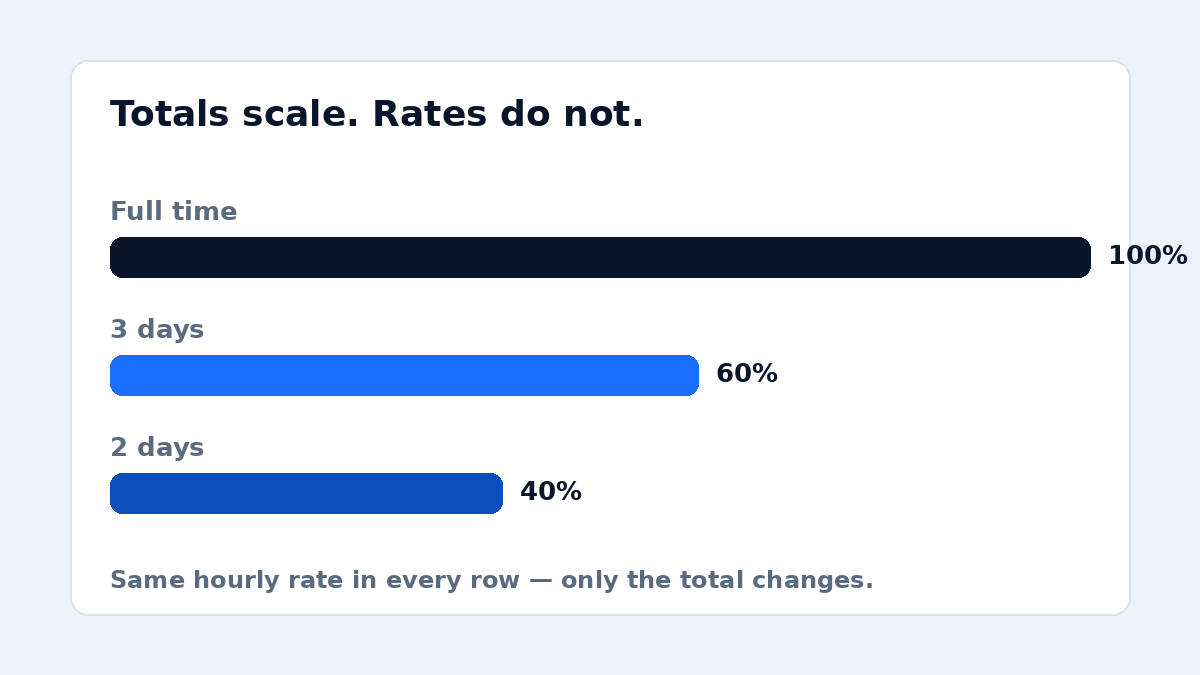
If you take one line from this page, take this one: pro rata never changes the rate — it changes only the total.
A £19-an-hour job is a £19-an-hour job whether it is worked full time or two days a week; what pro rata scales is the number of hours that rate is applied to. A £975-a-month flat costs the same per day whether you stay all month or half of it; pro rata scales the days. Once you hold that distinction — rates stay fixed, totals scale — every pro rata sentence you read becomes arithmetic you can check.
What does pro rata mean for salary?
In job adverts, “pro rata” (often written “pro-rata”, and in the US “prorated”) attaches to a salary that is not the salary for the hours advertised. The figure printed is the full-time equivalent; the hours printed are the part-time reality; your actual pay is the printed figure multiplied by your fraction of the full-time week. An advert reading “£29,400 pro rata, 18.5 hours per week (FTE 37)” is offering £14,700 a year, not £29,400 — a fact the advert is technically honest about and practically silent on. “What does pro rata mean salary” and “what does pro rata salary mean” are, between them, asked thousands of times a month precisely because this convention surprises every new part-time applicant once.
Three related phrases deserve decoding. “Per annum pro rata” means the full-time figure is an annual one — nothing more. “Actual salary £X” or “salary shown is the actual pay for the hours stated” means the reduction has already been done and no fraction should be applied — applying one anyway is the double-reduction error. “FTE salary” and “full-time equivalent salary” both label the un-reduced figure. If an advert uses none of these clarifiers, the two questions to ask before applying are set out in our article on checking a pro rata job advert: what is the full-time salary, and what are the full-time hours?
To turn meaning into money, use the pro rata calculator on the homepage or the salary calculator; to learn the manual method, the step-by-step guide works four examples including £30,000 and £25,000.
The same phrase, everywhere else
Holiday. A part-time worker’s leave is the full-time entitlement scaled by the same fraction — 5.6 weeks of your own pattern is the legal floor. Full treatment: part-time holiday entitlement.
Rent. A part-month is priced as days occupied over days in the period, by one of two daily-rate methods. Full treatment: pro rata rent calculator.
Refunds and cancellations. Cancel a £480 annual membership after five unused months and a pro rata refund is 5/12 of £480: £200. Providers who deduct an “administration fee” from such refunds must say so in their terms; the pro rata part itself is not theirs to redefine.
Shares, bills and dividends. Household bills split pro rata by days in residence, company dividends paid pro rata to shareholdings, and costs divided pro rata to usage all predate the salary usage by centuries — the employment meaning is the newcomer, borrowed from commercial law in the twentieth century.
Tax-year changes. When allowances or thresholds change mid-year, accountants describe the blending of old and new rates across the year as pro rata temporis — “in proportion to time” — the full Latin phrase the short form comes from.
Three sentences, translated
“£33,500 per annum, pro rata, 22.5 hours.” Translation: full time here is 37.5 hours, your fraction is 0.6, your salary is £20,100.
“25 days’ holiday (pro rata for part-time staff).” Translation: full-time staff get 25 days plus whatever the contract says about bank holidays; at three days a week you get 25 × 0.6 = 15 days on the same basis.
“Rent will be charged pro rata for the period 10–31 March.” Translation: you pay for 22 of March’s 31 days — £691.94 on a £975 rent by the calendar method, or £705.21 by the annual method, which is why the method matters and why our rent calculator shows both.
Notice that in each translation the work is the same: find the whole, find the fraction, multiply. “What is pro rata” and “how does pro rata work” are therefore the same question at different depths — one asks for the sentence, the other for the sum — and you now have both.
Misunderstandings that cost money
The costliest is assuming the printed salary is yours. The second is its mirror image: assuming a salary already reduced will be reduced again. The third is believing pro rata is a lesser status — the phrase describes a fair share, and UK law on part-time work is built on exactly that principle: no less favourable treatment, measured pro rata. The fourth is accepting a pro rata figure with no visible fraction behind it. Any employer, agent or provider using the phrase should be able to show you the whole amount and the fraction in one breath. If they cannot, the figure is a guess wearing a Latin costume.
Questions people ask
The printed salary belongs to the full-time version of the job, and you receive the share of it that matches your share of the working week. Everything else — the Latin, the leave, the rent — is that one idea applied in different places.
Per annum just means “per year”. “£29,000 per annum pro rata” is an annual full-time salary of £29,000, reduced by your fraction. The two phrases together cause most confusion because both shorten the real sentence, which is: the full-time annual salary is £29,000 and your pay is in proportion to it.
Yes — prorated is the American English form of the same Latin root, used across US payroll and billing. UK law, GOV.UK and UK contracts use pro rata. The arithmetic is identical on both sides of the Atlantic.
If you work more than the stated pattern, yes: overtime beyond full-time hours is sometimes described as pro rata above 1.0 FTE. More commonly, confusion arises when an advert states the actual part-time salary and still adds “pro rata” out of habit — in which case applying the fraction again would wrongly reduce it twice. Always ask which of the two figures you are looking at.
Performance bonuses are often pro-rated by the same fraction for part-time staff, and the Part-time Workers Regulations support that treatment unless a difference can be objectively justified. Commission usually follows earnings actually made, so it self-adjusts. Your contract should state the treatment of each element separately.