 ProRata Calculate
Before You Apply: How to Decode a “£X Pro Rata” Job Advert
Here is a familiar small misery. You find a job you actually want. The description is good, the hours suit your life, and then the salary line reads: “£31,000 per annum, pro rata.” No hours for the full-time version. No actual salary for the hours on offer. Just a Latin phrase standing where your income should be.
Employers are not (usually) being sinister. “Pro rata” is payroll shorthand, and the people writing adverts live inside it. But shorthand that hides the pay is still hiding the pay, and you are entitled to decode it before you spend an evening on an application form. Here is how, using three adverts in the style you will meet every week on UK job boards.
Advert one: the honest one
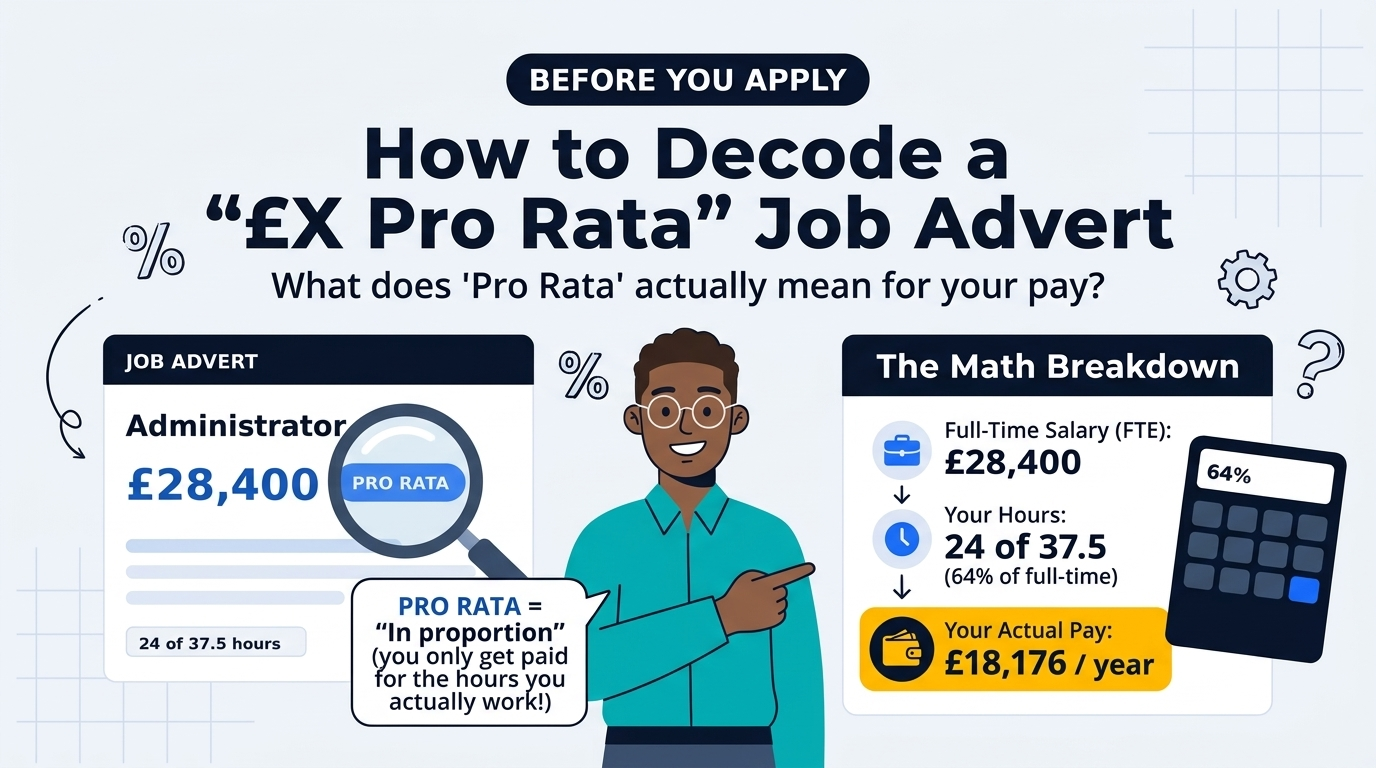
“Administrator, £28,400 pro rata. 24 hours per week, full-time hours 37.5.”
This is the good kind: everything needed is on the page. Your fraction is 24 ÷ 37.5 = 0.64. Your salary is £28,400 × 0.64 = £18,176 a year, £1,514.67 a month before deductions. The hourly rate is £28,400 ÷ (37.5 × 52) = £14.56 — write that down, because it is the figure your offer letter and first payslip must reproduce. Two minutes, done. If every advert were written this way, this article would not need to exist.
Advert two: the missing denominator
“Receptionist, £26,500 pro rata, part-time, 3 days per week.”
Better than nothing — but is full time five days or six? Is a “day” 7.5 hours or 9? If the workplace runs a five-day, 37.5-hour week, three days is 0.6 and the pay is £15,900. If reception cover runs six shorter days, the same “3 days” could be a fraction of 0.5 and the pay £13,250 — a £2,650 difference hiding behind one missing line. Do not guess, and do not let the interview be the first place the number appears. Email the contact on the advert two questions: what are the full-time hours, and what is the actual annual salary for the hours advertised? A competent employer answers in one line. An evasive answer is information too.
Advert three: the trap
“Teaching Assistant — salary £16,940 (pro rata). Term time only, 27.5 hours per week. Full-time equivalent £27,300.”
Read it twice, because this style catches experienced applicants. Has £16,940 already been reduced, or is it still to be reduced? Test it: 27.5 ÷ 32.5 school hours = 0.846; paid weeks (39 + 5.6) ÷ 52 = 0.858; £27,300 × 0.846 × 0.858 = £19,813 — not £16,940. Try assuming £16,940 is the already reduced figure for a slightly different weeks count and it reconciles closely enough to be plausible. The advert is genuinely ambiguous, and the two readings differ by nearly £3,000 a year. This is the double-reduction trap: if you apply the fraction to a figure that has already had it applied, you halve the job in your head and may walk away from a fair offer — or, worse, accept an unfair one because you assumed the reduction was still to come. The only safe move is the same email as before, asking one precise question: “Is £16,940 the actual annual pay for the advertised hours and weeks, before tax?” Yes or no. Nothing else settles it.
The three questions that decode any advert
One: what is the full-time salary? If the advert’s figure is labelled FTE, full-time equivalent, or “per annum pro rata”, that is the whole from which your share is cut. Two: what are the full-time hours (and, for term-time posts, the paid weeks)? The denominator is where good adverts differ from vague ones, and where payroll errors are born. Three: what is the actual annual salary for the advertised pattern? Ask for it as a number, not a formula. You can verify it in ninety seconds on our salary calculator or the term-time calculator — and if your verification and their number disagree, you have found the discrepancy before it became a payslip.
None of this marks you out as difficult. Candidates who ask precise pay questions look like candidates who read contracts, and schools, surgeries and councils — the heaviest users of pro rata in the UK — are used to these emails. What actually damages applicants is discovering the real salary after resigning from the previous job. Ninety seconds with a calculator, and one short email, is a cheap insurance policy. Take both out, every time.
Open the pro rata calculator → · Next: five pro rata pay mistakes →

Recent articles & guides
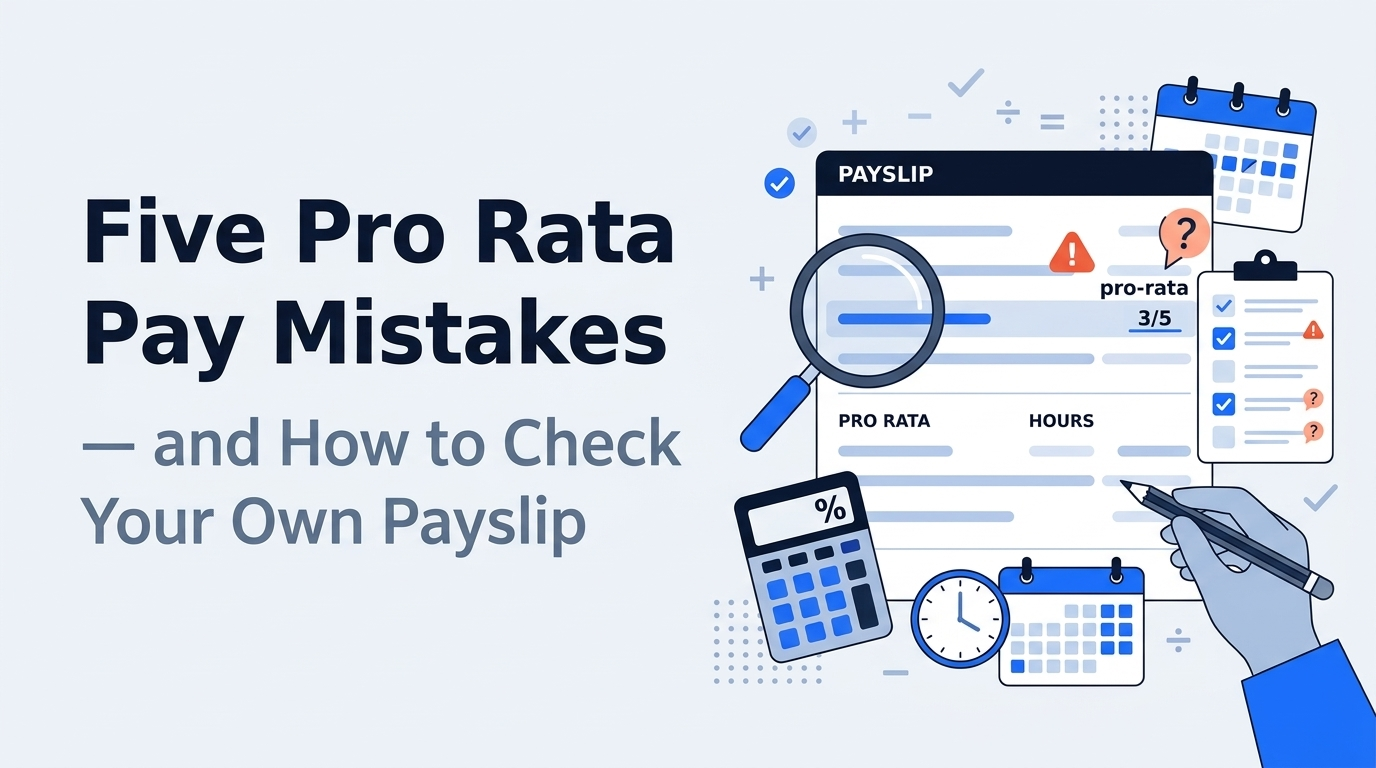
Five Pro Rata Pay Mistakes (and How to Check Your Own Payslip)
The mistakes that cost part-time workers money — holiday on the wrong days, missing term-time weeks, a fraction that froze — each with the check that exposes it.

Pro Rata Holiday Entitlement for Part-Time Workers
The 5.6-week legal floor, bank holidays, mid-year hour changes and auditing your own leave in about ten minutes.
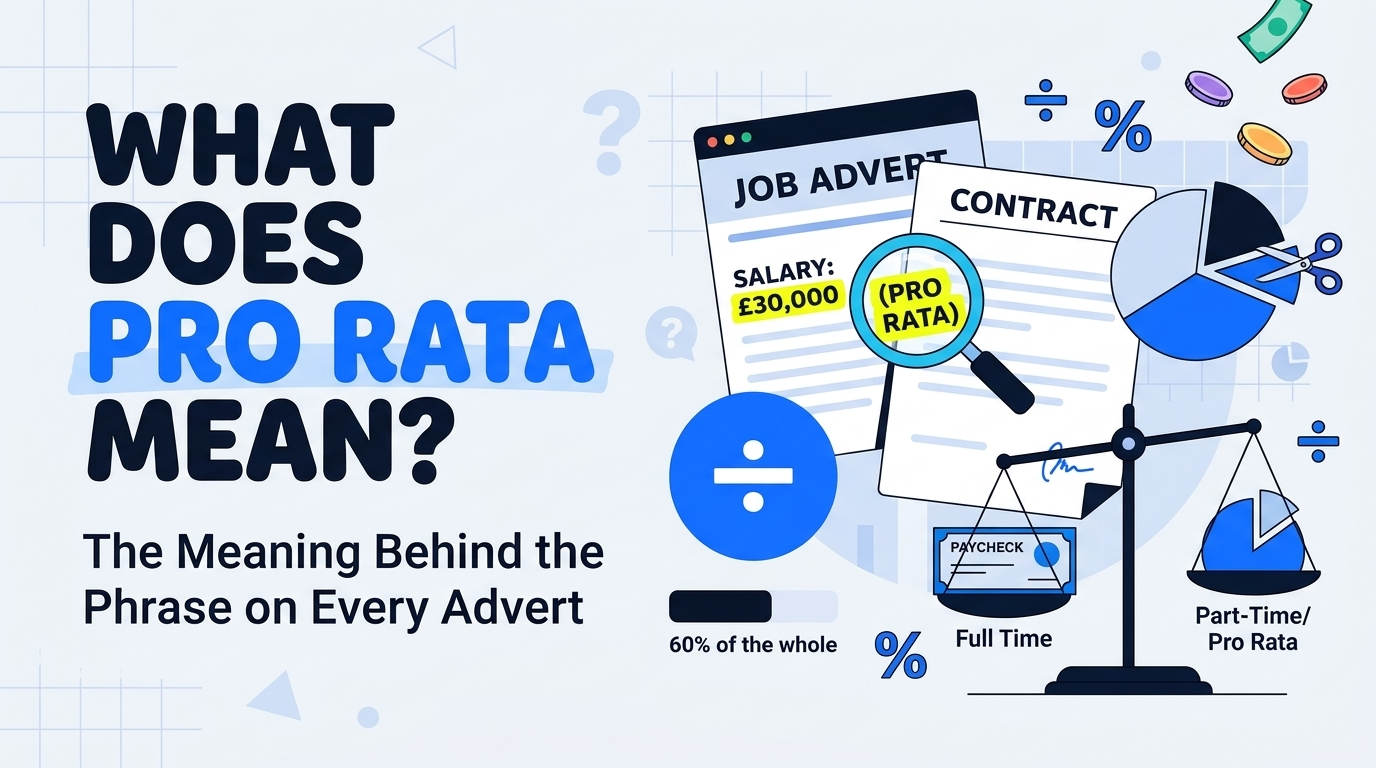
What Does Pro Rata Mean?
The phrase decoded in plain English — what it does to a salary, and how the same idea applies to holiday, rent and refunds.